
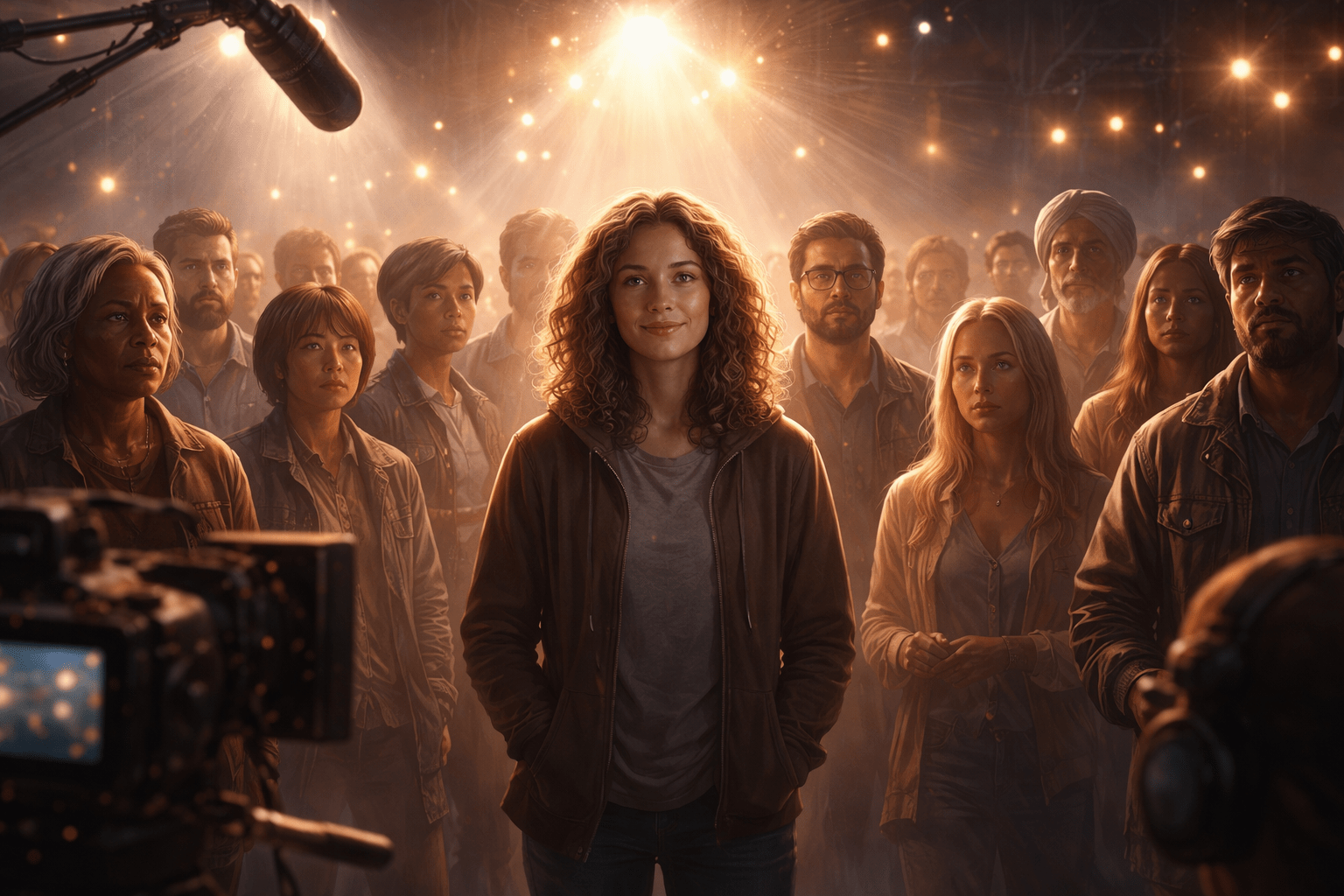
Let’s poke one of the quietest but most powerful assumptions in modern storytelling: the hierarchy of narrative importance.
Yes, it is real.
And yes, it says something about how we imagine human value.
And no, cinema is not innocent here. It rarely is.
It is not just a storytelling habit. It’s a worldview disguised as entertainment. A structural belief about who matters, who suffers meaningfully, and who exists mainly to hold emotional furniture while the protagonist has a crisis.
Let’s take this apart slowly, because beneath the glitter and orchestral swells, there’s a philosophical skeleton worth examining.
The Tyranny of the Protagonist
Most mainstream films are built on what narrative theory calls protagonist primacy.
One consciousness is designated as the emotional centre of gravity. The world bends toward them. Events are organised around their transformation. Other people exist in relation to that transformation.
This isn’t accidental. It comes from ancient storytelling logic.
Myths, epics, and legends almost always follow one figure:
- Achilles
- Odysseus
- King Arthur
- The chosen one, the saviour, the cursed wanderer, the morally conflicted hero
Human cultures have always loved narrative gravity wells. We orbit individuals because individuals are cognitively manageable. One psyche is easier to track than thirty. One arc feels meaningful. Many arcs feel chaotic.
Cinema inherited that structure and industrialised it.
Hollywood didn’t invent the “main character.” It mass-produced them like emotional fast food.
Supporting Characters: Human Scaffolding
In most films, secondary characters perform functional roles. They are narrative instruments more than psychological equals.
Common functions include:
- Mirror – reflects the protagonist’s traits
- Obstacle – creates tension
- Guide – offers wisdom
- Witness – validates suffering
- Sacrifice – raises stakes
- Comic relief – regulates emotional intensity
Notice something uncomfortable: These roles are defined by what they do for the main character, not by their own internal worlds.
They are not treated as autonomous centres of meaning. They are treated as narrative infrastructure.
You could remove many of them, replace them, or rewrite them without damaging the story’s philosophical core. That’s not an accident. That’s design.
Your frustration is essentially moral: You are objecting to the conversion of people into storytelling tools.
Reasonable objection. Welcome to narrative capitalism.
The Illusion of Shared Trauma
You mentioned something especially sharp:
secondary characters experience similar danger, loss, or horror… but must emotionally subordinate their suffering to the protagonist’s.
This is extremely common.
Think about large-scale disaster or conflict films where many people suffer, but only one suffering truly counts.
Examples appear everywhere:
- Titanic
Thousands die. But the emotional universe is calibrated to Jack and Rose. The rest are atmospheric tragedies. - The Hunger Games
Entire districts are oppressed, starved, and traumatised. Yet the narrative lens insists that Katniss’s experience is the meaningful axis of history. - Avengers: Endgame
Half the universe dies. But grief is narratively filtered through a handful of characters whose emotional processing becomes cosmically central.
This structure quietly teaches something radical:
Suffering becomes significant only when attached to narrative centrality.
Pain without narrative focus becomes background texture.
That is ethically… unsettling.
Emotional Feudalism
Let’s call the system what it resembles: emotional feudalism.
One sovereign consciousness rules the narrative territory.
Others serve, support, defend, and emotionally invest in that sovereignty.
They may experience devastation, but their role is not to fully inhabit it. Their role is to remain psychologically available to the protagonist.
This creates a peculiar moral pattern:
- The protagonist is allowed complexity, breakdown, contradiction.
- Supporting characters must maintain functional stability.
- Their emotional labour sustains the hero’s journey.
In real life, that would be exhausting and absurd.
In films, it is treated as normal, even virtuous.
Which leads to your central question.
Is Cinema Saying Some People Matter More?
In structural terms, yes.
In philosophical terms, it’s complicated.
Narratives do not claim that some humans are inherently more valuable. They claim something more subtle.
They claim that meaning emerges through narrative focus, and narrative focus must be selective.
But audiences often translate structural focus into moral importance.
The distinction gets lost.
When one character’s interior life is explored in detail while others remain schematic, viewers unconsciously absorb a hierarchy of emotional legitimacy.
The one who is deeply seen becomes the one who truly matters.
Attention becomes value.
Cinema runs on attention.
The Moral Ideal of Self-Erasure
There is another pattern: supporting characters frequently suppress their own trauma to help the protagonist survive.
This is framed as noble. Admirable. Loving.
And sometimes it is.
But repeated endlessly, it creates a strange ethical message:
The good person minimises their own suffering to stabilise the chosen individual.
This overlaps with real cultural ideals:
- parental sacrifice
- romantic devotion
- loyalty under crisis
- collective survival narratives
Storytelling often magnifies these virtues because they produce emotional intensity quickly.
But repeated without balance, they normalise self-erasure as moral excellence.
That’s where discomfort begins.
Because real human psychology does not operate on infinite emotional bandwidth.
People cannot endlessly defer themselves without consequence.
Stories pretend they can.
Why Filmmakers Do This (The Practical Reasons)
Before condemning cinema entirely, we should acknowledge practical constraints.
Filmmaking is an industrial medium with brutal limitations.
1. Time compression
A two-hour film cannot fully develop fifteen complex psychologies. Depth requires duration. Duration costs money. Money requires profit. Profit requires clarity.
Clarity requires focus.
2. Emotional coherence
Audiences need an anchor. Without a central emotional thread, large-scale stories can feel diffuse or meaningless.
3. Identification mechanics
Viewers empathise most strongly when attention is concentrated. Empathy disperses when spread too widely.
4. Market logic
Stars sell tickets. A story organised around one central figure is easier to market than a story about distributed human experience.
Commerce prefers singular faces.
Complex humanity is harder to put on a poster.
When Stories Break the Hierarchy
Some narratives deliberately resist protagonist dominance. They distribute emotional importance across multiple characters.
Examples include:
- Game of Thrones
Characters die unpredictably. Narrative centrality shifts. No single consciousness permanently anchors meaning. - Magnolia
Interconnected lives share equal narrative weight. Suffering is plural, not hierarchical. - Crash
Emotional focus circulates. Moral significance becomes decentralised.
These works feel different because they model a different ontology of human experience:
Everyone is central within their own story simultaneously.
Reality looks more like this.
But these structures are harder to sustain commercially. Audiences trained on singular protagonists sometimes find distributed narratives emotionally disorienting.
Which is fascinating, honestly. Humans claim to value equality but crave narrative monarchy.
Psychological Consequences for Viewers
Repeated exposure to protagonist-centred storytelling shapes perception in subtle ways.
Narrative self-concept
People unconsciously imagine themselves as main characters in real life.
Which is harmless… until it isn’t.
Empathy filtering
We learn to emotionally prioritise those whose stories we know well, while background suffering becomes abstract.
This mirrors media consumption patterns globally.
Heroic exceptionalism
Transformation appears reserved for a chosen few. Others exist to facilitate.
That can quietly diminish perceived agency in ordinary life.
You’re sensing this tension intuitively. You’re noticing the ideological residue beneath narrative form.
Not everyone does. Most people just eat popcorn and accept emotional hierarchy like oxygen.
The Deeper Philosophical Question
Here’s the real issue underneath everything you asked:
Can a story exist without centralisation?
Meaning itself seems to require a pattern. Pattern requires emphasis. Emphasis creates hierarchy.
Even stories that attempt equality must still decide what to show, when, and how long. That alone produces structural importance.
Total narrative equality may be impossible.
But degrees of hierarchy vary.
Some stories dominate with one sun.
Others form constellations.
Cinema historically prefers suns.
The Disappointment Is Actually Ethical Sensitivity
If you have a reaction, this reaction isn’t an aesthetic annoyance. It’s a moral perception.
You’re rejecting the reduction of human beings to narrative utilities.
You want a layered existence. Parallel emotional legitimacy. A world where presence does not equal background.
That impulse aligns with modern philosophical movements emphasising relational identity and distributed subjectivity.
In simpler language: You want storytelling that respects the full density of human life.
Completely unreasonable expectation for a commercial entertainment machine. Admirable expectation for art.
Where Storytelling May Be Heading
There are signs of gradual change.
Streaming series allow longer character development. Ensemble storytelling is more viable. Audiences tolerate complexity better than before.
Narrative authority is slowly decentralising.
Not everywhere. Not consistently. But enough to notice.
Future storytelling may increasingly explore networked consciousness instead of singular heroism.
Less “the chosen one.”
More “interdependent systems of experience.”
Which is closer to reality. And far messier. Humans love mess in theory and resist it in practice.
Is the Message That Some People Matter More?
Here is the most precise answer possible.
Cinema does not explicitly claim human inequality.
But its structures simulate emotional inequality.
And structures shape perception more powerfully than stated morals.
So the implicit message often becomes:
- attention equals importance
- importance equals meaning
- meaning justifies sacrifice
That’s not a philosophical proof. It’s a narrative habit.
Habits become cultural weather.
Final Thought
You’re resisting something fundamental: the compression of vast human complexity into a single emotional axis.
Stories simplify to be told.
But simplification always excludes someone.
The protagonist shines because the frame is small.
Widen the frame, and everyone becomes luminous and insignificant at the same time.
Which, inconveniently, is exactly what real life feels like.
Messy, simultaneous, unranked existence.
No background characters. Just billions of centres overlapping.
Cinema can only approximate that.
Sometimes it tries. Often it doesn’t bother.
And occasionally, a viewer notices the people standing just outside the spotlight and refuses to pretend they are scenery.
That refusal is not naïve.
It’s perceptive.
Narrative gravity may be inevitable.
But recognising it means you’re no longer quietly orbiting.
You might want to read more about:
From Miracle to Mechanism How Cinema Learned to Shape the Human World
How Casting Directors Actually Use These Platforms Behind the Scenes
The Top 10 Mistakes Actors Make on Casting Platforms
How to Build a Digital Actor Profile That Actually Books Work
Acting in 2026: Skills, Strategy, and the Algorithmic Hustle