
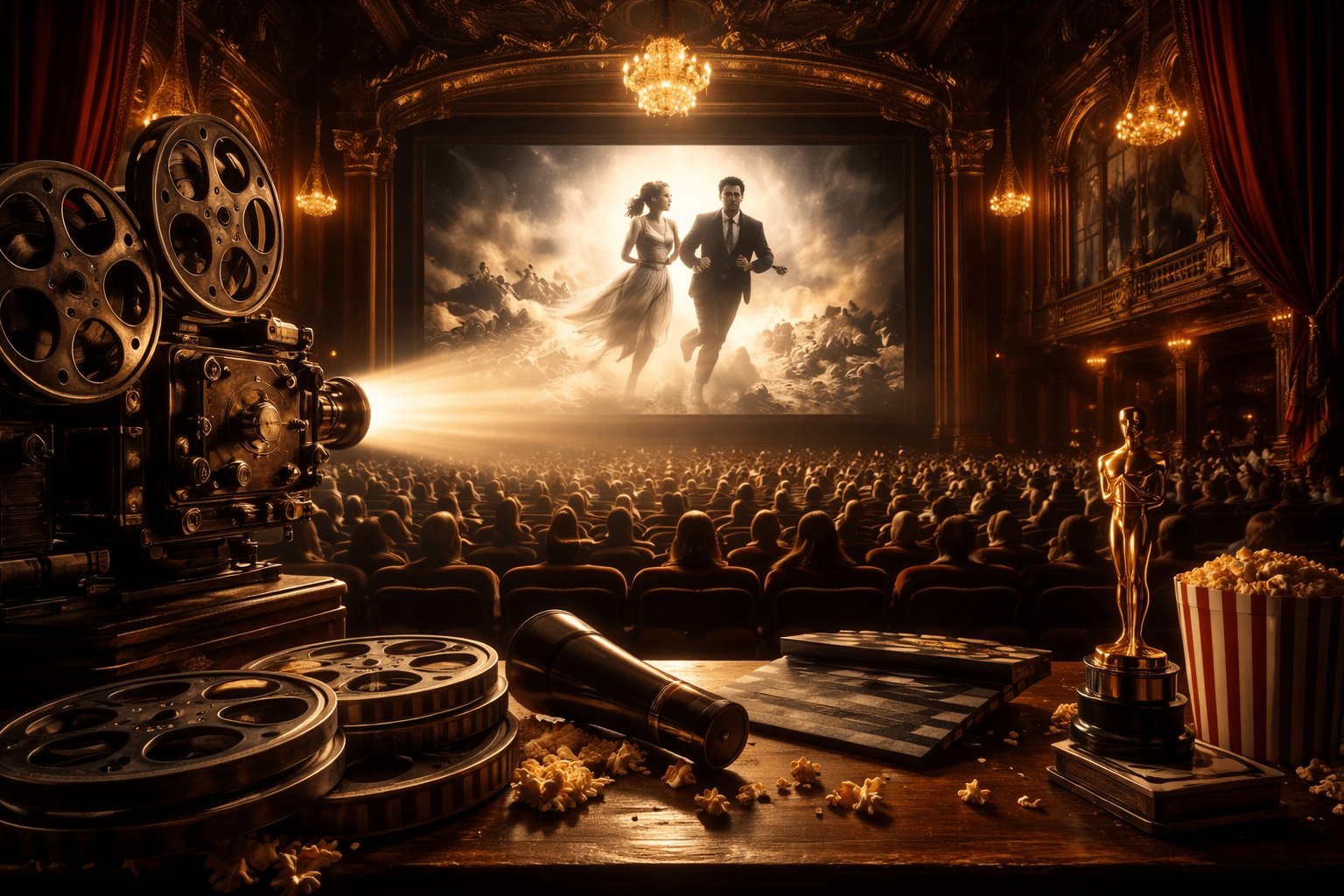
There was a time when film was not an industry, not a habit, not background noise in a tired living room. It was a phenomenon. A rupture in perception. A trembling doorway through which reality briefly escaped its own rules.
Imagine the moment: light passing through mechanical shutters, striking a surface, becoming movement. People who were not present suddenly appear before you. Walking, breathing, laughing, existing inside a contained frame. Not drawings, not written descriptions, not retold memories, but bodies in motion. Preserved presence. Captured time.
When audiences first watched the projections of the Lumière brothers, something fundamental shifted. Humans had spent centuries learning to represent reality through symbols. Spoken language reduced life to sound. Writing reduced it further to marks. Painting flattened it into stillness. But cinema restored motion. It returned rhythm, gesture, expression. It gave the illusion that life itself had been seized and replayed.
It is difficult for modern eyes to grasp the magnitude of this transition because we were born into saturation. Screens greet us before language fully forms in childhood. But for those who encountered moving images for the first time, it was not entertainment. It was a revelation.
Human beings had learned to tell stories. Now stories appeared to tell themselves.
That distinction changed everything.
The Ancient Human Hunger to Witness
Before cinema, humanity survived by sharing experiences indirectly. A hunter described the animal. A singer preserved a battle. A writer documented a ruler. Knowledge travelled through interpretation. Every retelling carried distortion, emphasis, omission. Memory reshaped events into narrative form, and narrative reshaped collective belief.
Cinema seemed to eliminate the interpreter.
What appeared on screen looked like proof. Evidence. Presence. A visual claim to truth.
This is where the miracle became something more than technological. It became a psychological authority. If something could be seen, it felt verified. If it could be replayed, it felt permanent. If many people watched it together, it felt collectively confirmed.
Human perception had been given external storage.
And once perception can be stored, it can also be curated.
The Industrialisation of Vision
The early years of cinema were filled with astonishment. But astonishment is unstable. Humans acclimate quickly. What shocks one generation becomes ordinary to the next. The miracle did not vanish. It simply became infrastructure.
When the production of moving images was gathered into centralised systems, cinema crossed a threshold. It ceased being an invention and became an apparatus. A network of labour, capital, distribution, and influence. A machine capable of manufacturing emotional experiences on a scale.
This transformation found its most recognisable form in Hollywood, where storytelling became systematised with industrial precision. Scripts were structured for maximum engagement. Performers were selected not only for talent but for symbolic resonance. Narratives were engineered for broad appeal. Visual language became standardised. Genres stabilised into recognisable formulas.
What had once been an experimental expression hardened into a repeatable design.
This was not an artistic accident. It was economic evolution. Anything capable of reliably capturing attention becomes valuable. Anything valuable becomes organised. Anything organised becomes optimised.
Cinema became efficient at producing meaning.
Narrative as Behavioural Blueprint
Once the film achieved scale, it began to perform a function beyond storytelling. It became a rehearsal space for living.
Audiences did not merely observe fictional worlds. They absorbed patterns. They learned what courage looks like, what romance looks like, what success looks like, what failure looks like. Emotional responses were modelled, repeated, reinforced.
Cinema did not invent human roles, but it amplified and codified them.
Masculinity acquired visual grammar. Authority acquired posture. Desire acquired a gesture. Vulnerability acquired acceptable limits. Even rebellion acquired style.
The hero became a central organising structure. The chosen individual whose significance outweighs the collective. The narrative gravity that bends all surrounding lives into supporting roles. This structural choice, repeated endlessly, trains perception. It suggests that importance is hierarchical, that destiny selects, and that most lives function as context rather than centre.
This is not simply storytelling convenience. It is worldview architecture.
Repeated long enough, narrative patterns begin to feel natural. What is constructed becomes assumed. What is assumed becomes internalised.
Cinema does not merely depict culture. It participates in manufacturing it.
The Aesthetic of Violence
One of the most striking consequences of cinematic evolution is the transformation of violence into spectacle. Death, once immediate and irreversible, became representable without consequence. Bodies fall. Blood flows. The story continues.
Exposure reshapes sensitivity. Repetition recalibrates response. When destruction appears frequently and without lasting psychological weight, perception adjusts. The extraordinary becomes familiar. The unthinkable becomes dramatic punctuation.
Violence becomes visual language rather than existential rupture.
At the same time, narrative frameworks selectively preserve certain lives. The protagonist survives what would destroy others. This imbalance communicates implicit valuation. Some lives are structurally protected. Others are expendable.
This is not simply fiction. It is a symbolic hierarchy expressed through survival probability.
The audience learns not only to endure simulated catastrophe, but to expect asymmetry within it.
The Birth of Symbolic Humans
Cinema did something else unprecedented. It transformed individuals into cultural constants.
When faces appear repeatedly on massive screens, they detach from ordinary scale. They become symbols rather than people. Their expressions become templates for emotion. Their decisions become moral reference points. Their presence shapes collective taste.
Celebrity is not merely fame. It is a symbolic concentration. A single human body carrying enormous interpretive weight.
Institutions such as the Academy of Motion Picture Arts and Sciences formalised this symbolic system by assigning recognition, legitimacy, and hierarchy within the field of representation. Achievement in performance became culturally certified significance.
Recognition became a ritualised validation of influence.
Actors did not simply perform characters. They mediated cultural imagination.
Entertainment as Soft Authority
Language evolves to soften power. “Entertainment” is a gentle word. It suggests diversion, pleasure, leisure. But any medium capable of shaping perception, emotion, and expectation operates as influence regardless of intention.
Cinema instructs without declaring instruction. It persuades without announcing persuasion. It embeds assumptions within narrative pleasure. Viewers lower their defences because the experience feels voluntary.
This is soft authority. An influence that operates through attraction rather than enforcement.
Humans rarely resist what they enjoy.
The Emotional Economy of Images
Modern life is saturated with mediated experience. Many individuals encounter emotional extremes more frequently through screens than through direct events. Love, war, betrayal, triumph, catastrophe. All available instantly, repeatedly, and without personal risk.
Cinema became a distributor of intensified feeling.
This has complex consequences. On one hand, it expands empathic range. Viewers can experience perspectives beyond their own circumstances. They can imaginatively inhabit unfamiliar lives. This is one of cinema’s most profound gifts: emotional mobility.
On the other hand, repeated exposure to heightened experience can distort scale. Ordinary life may appear insufficient by comparison. Expectations rise. Thresholds shift. Emotional intensity becomes normalised.
Reality must compete with simulation.
The Loss and Persistence of Wonder
Something subtle has changed over time. The early experience of cinema involved astonishment at the medium itself. Today, attention is directed primarily toward content. Technology recedes into invisibility. The miracle becomes assumed infrastructure.
Yet the fundamental phenomenon remains extraordinary.
In a darkened room, strangers gather. A beam of light projects patterned movement. For a fixed duration, separate consciousnesses synchronise around a shared narrative stream. Breathing patterns align. Emotional responses converge. Silence becomes communal. Reaction becomes collective.
This is coordinated imagination.
Few human inventions create a temporary unity of perception on such a scale. Cinema remains a form of organised dreaming.
Commerce and Meaning
Whenever meaning can be reliably produced, commerce emerges. This is not a corruption of art but a consequence of human systems. Resources flow toward influence. Influence generates return. Return sustains production.
The film industry did not destroy cinema’s artistic dimension. It stabilised its reproduction. But stabilisation comes with constraints. Efficiency favours predictability. Predictability favours familiar structures. Familiar structures reinforce existing expectations.
Innovation becomes risk. Repetition becomes safety.
Over time, industrial logic shapes creative possibility. Not absolutely, but persistently.
The Double Nature of Cinema
Cinema occupies a paradoxical position. It is simultaneously expressive and prescriptive, liberating and constraining, illuminating and shaping. It reflects human experience while also reorganising it.
It is a mirror and a mould.
Through film, humanity observes itself performing itself. Behaviour becomes visible. Identity becomes externalised. Cultural myths become dramatised. And through repetition, these dramatisations feed back into lived reality.
Cinema is not separate from society. It is one of the mechanisms through which society imagines and reimagines itself.
The Question of Responsibility
If a medium possesses the capacity to influence perception at scale, questions of responsibility inevitably arise. Who decides what is shown? Whose experiences are centred? Which lives are protected narratively? Which perspectives are marginalised or erased?
Every representation includes selection. Every selection carry implication.
Cinema cannot be neutral because framing itself is an act of interpretation.
Yet responsibility is distributed. Creators shape content. Institutions shape distribution. Audiences shape demand. Economic systems shape viability. Cultural values shape reception.
The film industry is not an external force imposed upon humanity. It is an emergent structure generated by collective participation.
The Future of the Moving Image
The trajectory continues. Screens multiply. Distribution accelerates. Production tools become accessible. The boundary between creator and viewer blurs. Narrative authority fragments across platforms. The centralised industrial model coexists with decentralised expression.
Cinema no longer resides only in theatres. It permeates everyday environments. Personal devices deliver continuous visual storytelling. Individuals document and broadcast their own lives. Reality and representation intertwine more densely than ever before.
Humanity is becoming increasingly accustomed to living in simultaneous layers of direct and mediated experience.
The original miracle has expanded beyond projection. Movement itself is now ubiquitous.
Returning to the Beginning
Despite all transformation, it is worth remembering the first astonishment. The simple fact of captured motion. Light arranged into presence. Time replayed.
Cinema began as an act of preservation. A way to hold fleeting reality still long enough to examine it. That impulse remains valuable. The ability to witness lives beyond one’s immediate reach expands understanding. The ability to record events prevents disappearance. The ability to share experience builds connection.
The danger lies not in the medium itself but in forgetting its power.
When something becomes ordinary, scrutiny fades. When scrutiny fades, influence deepens unnoticed.
The End of Innocence
Film is no longer the eighth miracle of the world in the sense of astonishment. Its novelty has dissolved into familiarity. But its capacity to shape perception has only intensified.
Cinema has moved from wonder to mechanism, from spectacle to system, from revelation to infrastructure.
It began by showing humans moving behind glass. It now participates in directing how humans move in life.
This transformation was gradual, almost gentle. No single moment marked the shift. It emerged through accumulation, repetition, normalisation.
The miracle did not vanish. It matured into power.
And power, once stabilised, rarely relinquishes influence willingly.
To watch a film is to participate in structured imagination. To create a film is to participate in structuring imagination. To distribute film is to participate in distributing possible ways of seeing the world.
Cinema is not merely entertainment. It is organised perception, emotional architecture, symbolic instruction, collective dreaming, industrial production, cultural negotiation, and technological wonder layered into a single phenomenon.
It remains one of humanity’s most extraordinary inventions precisely because it operates at the intersection of reality and imagination.
Light becomes movement. Movement becomes meaning. Meaning becomes belief. Belief becomes behaviour.
And all of it begins with shadows dancing on a surface, convincing the human mind that what it sees is alive.