
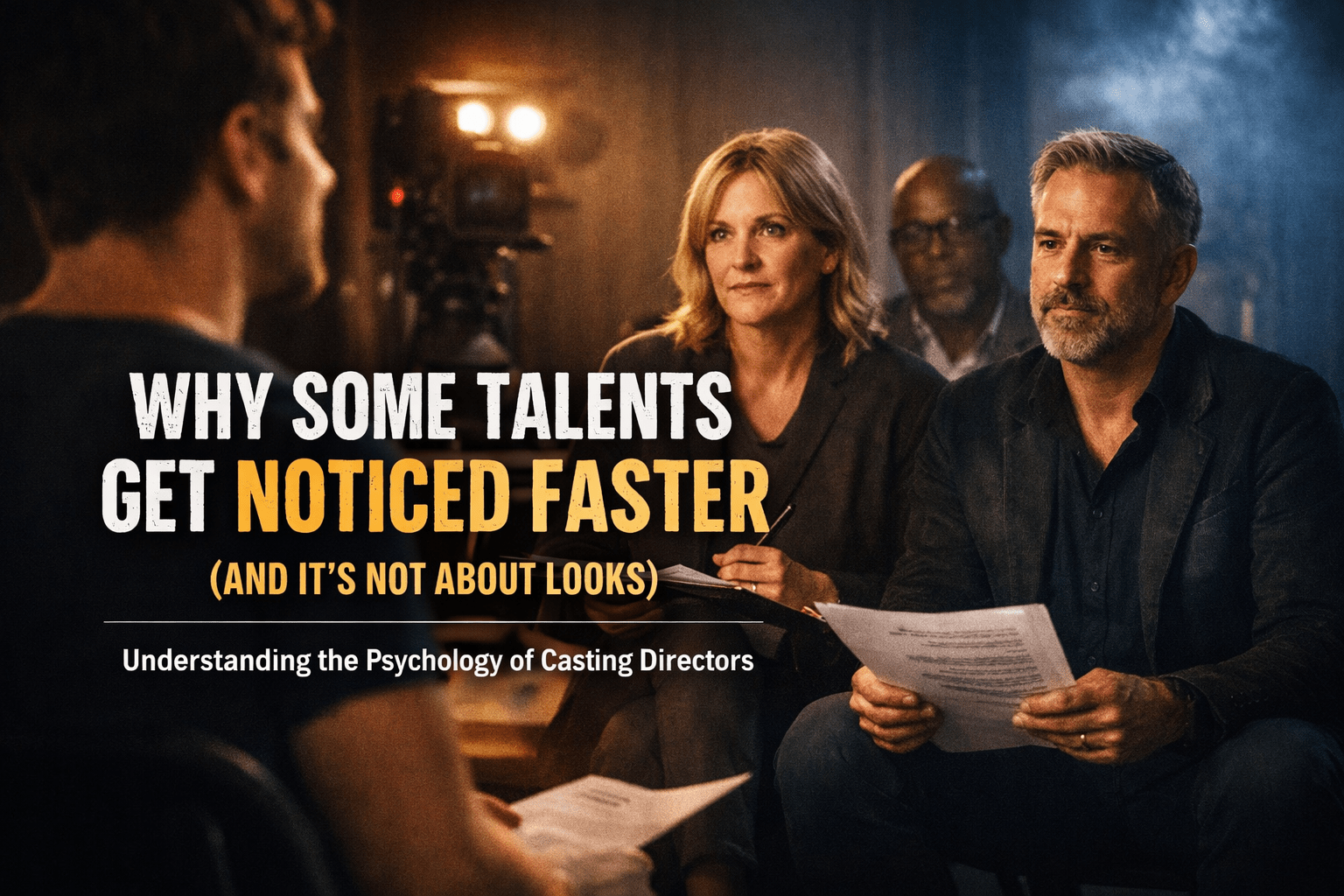
Why Some Talents Get Noticed Faster
(And It’s Not About Looks)
It’s tempting to believe the world is a beauty contest with a script. We hear it all the time: the pretty gets the part, the perfect face gets the camera, the gorgeous get the world. That’s a story we tell ourselves because it’s simple and savage, like a black-and-white film where the villain wears a mask, and the hero stands on a hill at sunset. But reality, especially in casting, is messier. It’s nuanced. It’s psychological.
Casting directors might flick a glance at your headshot before your reel, but they’re not falling in love with cheekbones in the first minute or two of meeting you. They’re scanning for something deeper, something that whispers, “This person lives here. In this character. In this world. In this film.” That’s why some talents get noticed faster, and the mechanism is not beauty; it’s a psychological grit, emotional truth, presence, and fit.
Here’s the anatomy of that truth.
The First Filter: It’s Not Beauty, It’s Relevance
Before we even get to auditions, most casting directors are looking for a fit, not faces. This is brutal but honest: if you don’t fit the character’s brief, you’re out before you open your mouth. Casting directors are trying to match the story’s needs, age, energy, narrative context, not your Instagram aesthetics. They’re filtering for fit first, because they often have dozens or hundreds of submissions to sift through.
This means:
- The headshot isn’t about “beauty,” it’s about believability.
- The look they want is the look of the story, not of a universal standard.
Looks still matter, sure, but only insofar as they support the story, not because someone decided someone’s face is pretty. That’s story logic, not fashion logic.
Casting directors are looking at your profile in three quick steps: your headshot, your showreel (or self-tape), and your résumé. If any of those don’t feel aligned with the project, you’re skipped.
Okay, you might say looks get you in the door. But story relevance decides whether you ever get noticed.
Thin-Slicing: Snap Judgments That Are Deeper Than You Think
There’s a real psychological concept called thin slicing: making split-second judgments based on tiny slivers of behaviour. People are doing this all the time. Casting directors absolutely do this, too. It’s not shallow; it’s efficient pattern recognition. Humans evolved to read people fast; for danger, for trust, for group fit. Casting directors use the same instinct to decide who they’ll actually spend more time with.
Within seconds of seeing you:
- They sense confidence or insecurity in your posture.
- They sense calm or chaos in your presence.
- They sense whether you’re present or just performing a mask.
That’s why a strong presence matters so much. Presence isn’t about loudness or pretty faces. It’s about being fully there, fully embodied. It’s about your psychological impact before you speak a word.
Presence is magnetic because it tells casting teams something quiet but true: this person can hold a room, can carry a character, can stay rooted amidst chaos and cameras and change.
Authenticity Over Perfection
Casting directors are sick of polished veneers that hide emptiness. What they want is authenticity, a performance that feels lived instead of delivered, that feels breathed instead of recited. This is a psychological truth: humans connect with realness, not flawless mimicry.
Authenticity is measured in subtle ways:
- Eye contact that feels intentional, not rehearsed.
- Reactions that feel felt, not copied.
- Choices that feel personal, not generic.
Actors who can make a moment feel true, even if imperfect, get noticed because they create something that feels like actual life, not plastic. Plastic might look good from a distance, but it doesn’t resonate.
That authenticity also signals emotional depth, the capacity to feel within the moment and make choices rooted in inner life, not just outward technique. Casting directors know this. They’re not fooled by pretty faces that don’t do anything.
Adaptability: The Unseen Trait That Outscores Looks
Here is where the real psychological game is played. Actors who get noticed aren’t just talented; they’re adaptable. Casting directors are watching not just what you do, but how you respond to direction. Change a line, shift the energy, flip the emotion, and see who keeps their centre and who crumbles.
Adaptability is a psychological muscle. It says to the casting team:
- I can receive feedback.
- I can adjust without losing core presence.
- I’m collaborative, not fragile.
Most people think an audition is about delivering their best version of a scripted performance. Casting directors use auditions to test how you work, because the job isn’t rehearsed moments; it’s on-set surprises. Adaptability matters more than flawless performance because it predicts how well you’ll survive the real world of a shoot.
Professionalism: The Quiet Hero of Casting Psychology
Here’s where everything gets a lot less glamorous. Talent is glitter. Professionalism is gravity. Casting directors notice when you:
- Arrive on time, cool, composed.
- Know your material.
- Respect the process and the people behind it.
- Carry yourself like someone committed to something bigger than their ego.
Professionalism tells casting directors something vital: you are reliable. In an industry fuelled by tight schedules and fragile egos, reliability is gold. It tells them you won’t collapse under pressure, won’t ghost calls, won’t cause chaos. It says you’re capable of getting through a shoot without consuming the production like a black hole.
Believe it or not, that predictability, that ease under pressure, that’s what gets people noticed fast.
Chemistry: The Invisible Force That Steals Roles
Actors are not islands. Every role sits in a constellation of relationships; someone has to have chemistry, someone has to respond, someone has to be believable in that web of human interaction. Casting directors are experts at spotting those invisible forces in a room.
Chemistry isn’t about flirting or sparkling. It’s about connection.
It’s about how your presence interacts with others.
It’s about emotional responsiveness in real time.
Actors who create resonance with scene partners, even in a cold audition room, are noticed because they offer something relational. Films are relationships; television is relationships; theatre is relationships. If you can show that you can do that thing, the thing where two actors breathe together and create life, you will be prioritised again and again.
Emotional Intelligence: The Sophisticated Edge
Casting directors are not just technicians; they’re psychologists in suits. They’re interpreting emotional cues with precision. They are scanning for empathy, emotional range, and self-awareness, because characters live in emotional complexity, not flat expressions.
Emotional intelligence allows an actor to:
- Navigate emotional beats with truth.
- Tap into nuanced human psychology under pressure.
- Regulate their own nervous energy.
This is the kind of talent that isn’t visible in a headshot or superficial performance. It’s felt, a texture in delivery, a nuanced rhythm in response, a psychological depth that makes characters breathe.
Casting directors know this instinctually. They feel it before they see it.
Presence: The Non-Visual Magnetic Force
Presence is the whisper before the word, the silence before the expression, the thing you can’t quite name. It’s the actor who doesn’t have the prettiest face or the longest résumé, but somehow the room stops when they walk in.
Presence is built from:
- Confidence without arrogance.
- Grounded embodiment of self.
- A psychological openness and attention to the moment.
It’s not something you wear. It’s something you are. And it shows up long before anyone looks at your headshot.
Social Influence and Digital Footprints (Yes, Even That)
Here’s a modern twist: casting directors increasingly check social media. They’re not shopping for selfies; they’re judging what your public presence says about your communication style, your emotional engagement with audiences, your persona beyond the audition room.
A strong online presence can:
- Demonstrate professionalism.
- Show range through diverse content.
- Reveal authenticity in how you express yourself publicly.
This isn’t vanity; it’s psychology. Casting directors are interpreting your digital self as a narrative extension of who you are, the uncurated parts included. That can be an edge if done with intention; it’s a liability if done like a chaotic diary.
Luck, Timing, and Unseen Forces
If we’re being honest, and you asked for honesty, sometimes it is about context, timing, and luck. Casting directors are still human. They still have tastes, biases, and moods. They still see two equally good actors and pick the one whose energy fits today’s narrative. They still adjust briefs at the last minute based on rewrites, producer inputs, or inner vibes of the room. It’s not logical. It’s not meritocratic. It’s human.
That doesn’t mean talent doesn’t matter. It means talent is only one variable in a complex psychological equation. Sometimes someone walks into the room and matches the director’s internal imaginary fix for a character you never saw. That’s unpredictable and maddening, and it’s real.
What Really Gets You Noticed Faster?
Here’s the distilled truth in you-can-digest-it form:
Talent is necessary but not sufficient.
Presence, authenticity, professionalism, adaptability, emotional intelligence, and chemistry are what make you unforgettable.
These are psychological forces, not aesthetic ones.
Looks might open the door, but psychological impact gets you remembered.
Casting directors aren’t magnets for beauty. They’re pattern detectors, storytellers, and emotional architects. They’re trying to find people who don’t just look like a character, but think like one, feel like one, embody one.
Your chance to be noticed isn’t in how well you present your face, it’s in how deeply and truthfully you are present.
That’s not a vanity contest. That’s a psychological audition. And now you understand the score.